Seismic Recording

Seismometers are instruments that measure and record motions of the ground, including those of seismic waves generated by earthquakes, nuclear explosions, and other seismic sources. Records of seismic waves allow seismologists to map the interior of the Earth, and locate and measure the size of these different sources. 

Seismograph is often used to mean seismometer, though it is more applicable to the older instruments in which the measuring and recording of ground motion were combined than to modern systems, in which these functions are separated. 

Seismoscopes which merely indicate that motion has occurred and perhaps with some simple measure of how large it was. 

The record of earthquake event is called seismogram.

A datalogger (also know as data acquisition system or DAS) is piece of electronic equipment which converts an input into a digital time series representation.


Types of seismometers: 

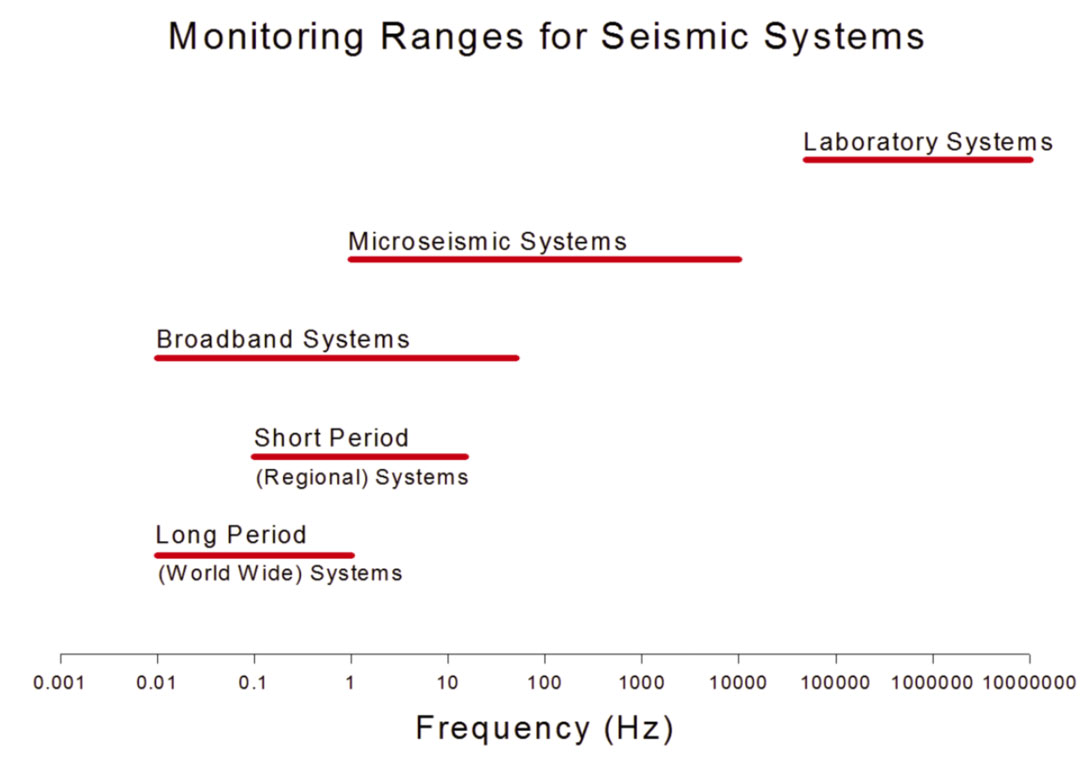
Broadband Sensors - are three-component seismometers capable of sensing ground motions over a wide frequency band. These sensors are most-often used in passive experiments. The flat-to-velocity portion of the bandwidth is generally about 0.01 Hz (100 sec) to 25Hz

Intermediate Sensors - are three component seismometers with corner periods in the 30- to 40-second range (distinct from the 120- to 240-second range of PASSCAL's truly broadband fleet). These sensors, like their broadband cousins, are capable of sensing ground motions of much longer period than their corner periods, if the long-period amplitudes are sufficient.

Short-Period Sensors - are rugged three-component seismometers that cover higher-frequency bands (usually 1 Hz to 100+ Hz). These sensors are used in both passive and active-source experiments. The sensors, themselves, can be either feedback seismometers requiring power or conventional, passive seismometers requiring no external power.

High-Frequency Sensors - are very rugged seismometers that cover even higher frequency bands (e.g. 4.5 Hz to 100+ Hz).  These sensors are most-often used in active-source experiments and are often referred to as geophones.

Accelerometers - also known as strong-motion sensors, are designed to measure the large amplitude, high frequency seismic waves typical of large local earthquakes, and operate in the frequency band 0 Hz to 100+ Hz.


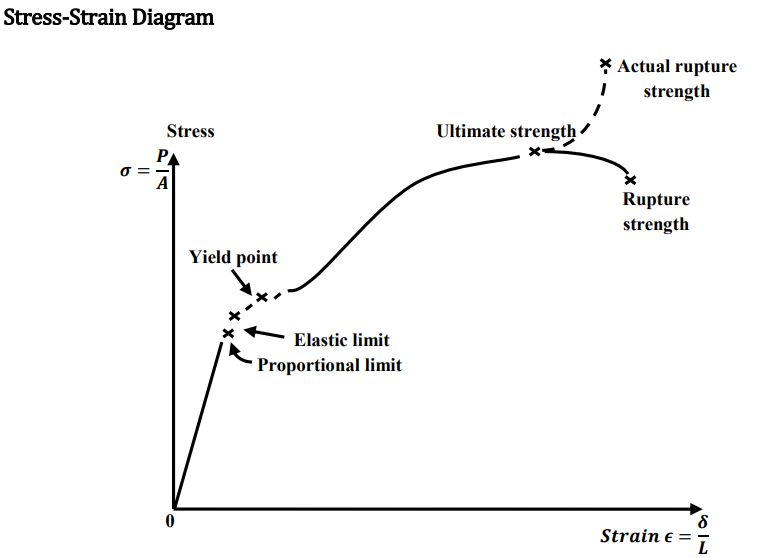
Proportional Limit: It is the point on the stress strain curve up to which stress is proportional to strain. 

Elastic Limit: It is the point on the stress strain curve up to which material will return to its original shape when unloaded. 

Yield Point: It is the point on the stress strain curve at which there is an appreciable elongation or yielding of the material without any corresponding increase of load; indeed the load actually may decrease while the yielding occurs. 

Ultimate Strength: It is the highest ordinate on the stress strain curve. 

Rupture Strength: It is the stress at failure

Mohr’s Circle 

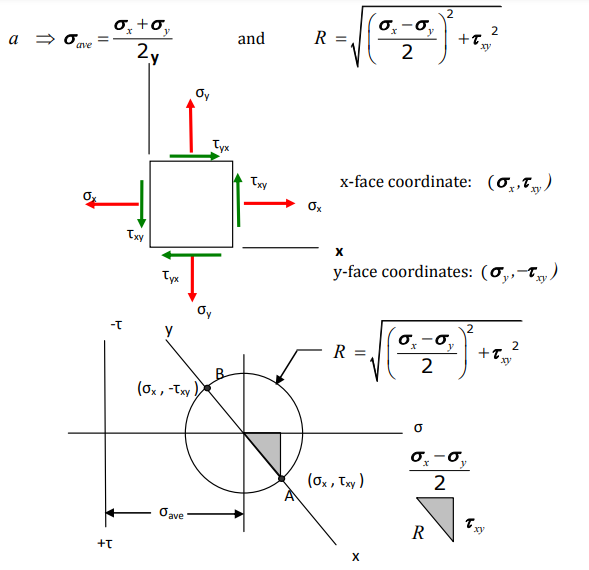
Mohr's circle gives us a graphic tool by which, we can compare the different stress transformation states of a stress cube to a circle. Each different stress combination is described by a point around the circumference of the circle.


Notes:

  • + τ (opposite convension may also be used) (meaning counterclockwise around the cube) is downward 
  • - τ (meaning clockwise around the cube) is up on the axis 
  • + σ for tensile stress
  • - σ for compressive stress
  • A rotation angle of θ on the stress cube shows up as 2θ on the circle diagram and rotates in the same direction. 
  • The largest and smallest values of σ are the principle stresses, σ1 and σ2. 
  • The largest shear stress, τmax is equal to the radius of the circle, R. 
  • The center of the circle is located at the value of the average stress, σave
  • If σ1 = σ2 in magnitude and direction (nature) the Mohr circle will reduce into a point and no shear stress will be developed.
  • If the plane contain only shear and no normal stress (pure shear), then origin and centre of the circle will coincide and maximum and minimum principal stress equal and opposite. σ1= + τ , σ2 = - τ 
  • The summation of normal stresses on any two mutually perpendicular planes remains constant. σx + σy = σ1 + σ2 

Share:

GATE Questions Radioactivity Method

GATE 2020

1. . Nuclide A decays to nuclide B exclusively through \(\alpha\) and \(\beta\) decay, such that the mass number is reduced by 32 and the atomic number is reduced by 10. The number of  \(\beta\) particles emitted during the decay of Nuclide A to nuclide B is .


2. The half- life of a parent radionuclide is 100yrs. If the parent radionuclide decays to daughter radionuclide which itself decays with a decay constant of \((1/4)^{th}\) that of the parents radionuclide, then radioactive equilibrium will be reached after years. (Round off to 2 decimal places). (Assume at time t = 0 the number of daughter radionuclide is zero)

GATE 2019

1. The abundance of \(^{234}U\) in secular equilibrium with its parent \(^{238}U\) will be   \(\times 10^{-3}\) %. (Given Half-life (\(T_{1/2}\) of \(^{238}U\)  and \(^{235}U\) are 4.467 × 10⁹ y and 2.44 × 10⁵ y, respectively, and abundance of \(^{238}U\) is 99.28%)(round off to 2 decimal places).

GATE 2018

1. The ratio of the number of daughter nuclides to the number of parent nuclides after a decay period of 3 half-lives is .

GATE 2017

1. The ratio of the number of daughter nuclides to the number of parent nuclides after a decay period of 3 half-lives is .


GATE 2016

1. The ratio of the number of daughter nuclides to the number of parent nuclides after a decay period of 3 half-lives is .


GATE 2015


1. The ratio of the number of daughter nuclides to the number of parent nuclides after a decay period of 3 half-lives is .


GATE 2014

1. The ratio of the number of daughter nuclides to the number of parent nuclides after a decay period of 3 half-lives is .


GATE 2013

1. The ratio of the number of daughter nuclides to the number of parent nuclides after a decay period of 3 half-lives is .


GATE 2012

1. The ratio of the number of daughter nuclides to the number of parent nuclides after a decay period of 3 half-lives is .


GATE 2011


1. The ratio of the number of daughter nuclides to the number of parent nuclides after a decay period of 3 half-lives is .


GATE 2010

1. The ratio of the number of daughter nuclides to the number of parent nuclides after a decay period of 3 half-lives is .


GATE 2009


1. The ratio of the number of daughter nuclides to the number of parent nuclides after a decay period of 3 half-lives is .


Share:

GATE Questions Electrical

GATE 2020

1. Ten equisplaced metal electrodes are arranged along a profile for multi-electrode 2D resistivity imaginary survey. If Wenner array is used for data recording, the maximum number of observations will be 

(a) 7     (b) 11     (c) 12     (d) 13

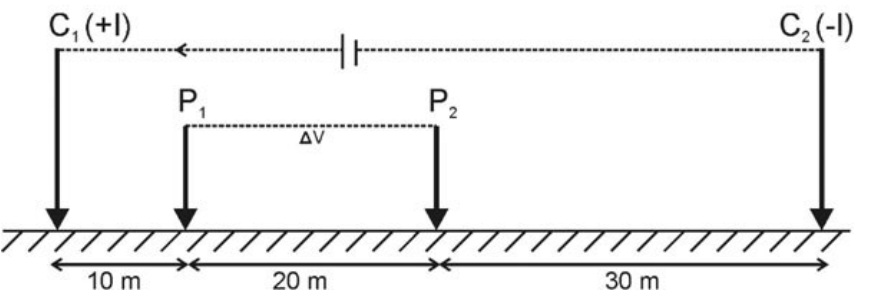
2. Current and potential electrodes in resistivity survey over an inhomogeneous ground is shown in the shown in the figure below. If 100mA current flow between C1 and C2 generates 50mV potential difference between P1 and P2 , then the apparent resistivity of the medium will be ____ohm-m. (Round off to 2 decimal places) (Use \(\pi=3.14\))

3. The means the resistivity of a horizontally stratified cuboid rock sample is 100 oohm- m and coefficient of electrical anisotropy is 1.15. The transverse resistivity of the rock sample_____ohm-m. (Round off 2 decimal places)

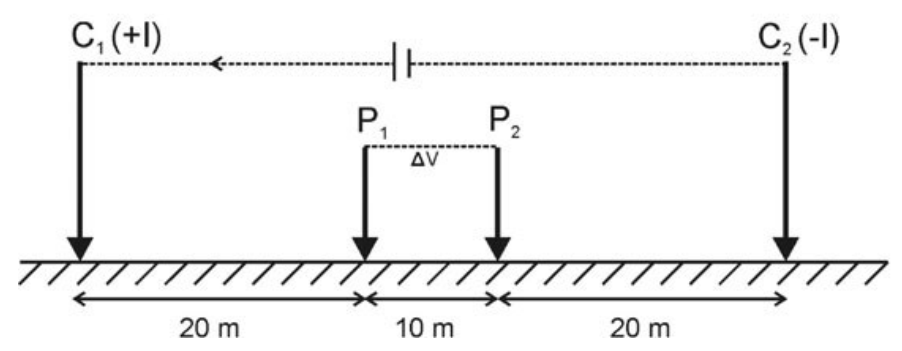
4. The ‘Geometrical factor’ for the electrode configuration given below will be _______ m. (Round off to 2 decimal places) (Use \(\pi = 3.14\)) (C1 and C2 are current electrodes; P1 and P2 are potential electrodes)

GATE 2019

1. The difference in the mobility of ions in the electrolyte and electrons in metallic conductors in the sub-surface due to applied external electric field gives rise to _________ . 

(a) electrode polarization         (b) membrane polarization 

(c) electro-kinetic potential         (d) electro-chemical potential

2. A massive sulphide body in the subsurface is partially above the water table. According to the pH variation hypothesis for the origin of Self Potential, which one of the following statements is CORRECT for such a body? 

(a) Acidic above and basic below the water table. 

(b) Basic above and acidic below the water table. 

(c) Acidic above and below the water table. 

(d) Basic above and below the water table.

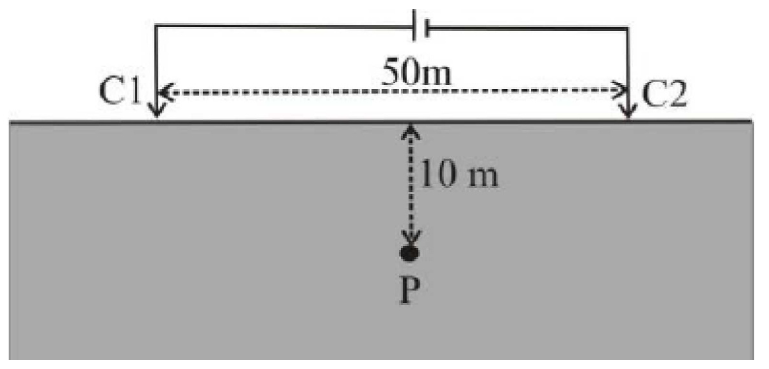
3. A pair of current electrodes C1 (+I) and C2 (–I) is placed 50m apart (shown in the figure below) over a homogeneous structure of resistivity 100 ohm-m and 1 Ampere current flows through the subsurface. Which one of the following is CORRECT for the potential (Vp ) and horizontal component of electric field (Ex) at a point P located exactly below the midpoint between Cl and C2 at a depth of 10 m?

(a) Vp = 0 and Ex = 0     (b) Vp = 0 and Ex \(\neq\) 0 
(c) Vp \(\neq\) 0 and Ex = 0     (d) Vp \(\neq\) 0 and Ex \(\neq\) 0

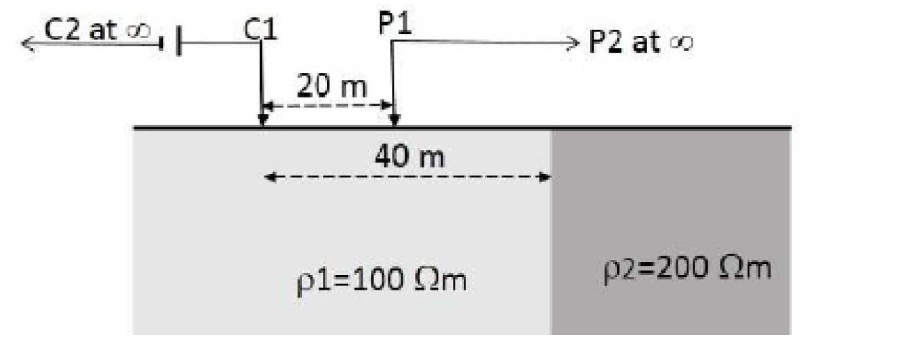
4. A Two-electrode array is placed over a vertical contact (2-D) as shown in the given figure (strike of contact is perpendicular to the plane of paper). If 1 Amp current flows through the subsurface, then the potential at the potential electrode PI will be ____ millivolts. (round off to the nearest integer). (Consider structures with resistivity \(\rho_1\) and \(\rho_2\) to be laterally extending to infinity on both sides of the contact and also in the downward direction, C2 and P2 are grounded at infinity) (Use \(\pi\) = 3.14)
3. In an electrical resistivity imaging survey, Axial Dipole-dipole array is placed over an inhomogeneous structure. The centers of current and potential dipoles are separated by a distance of 100 m. The length of each dipole is 10 m. If 5 Amp current flows through the subsurface and 50 mV potential difference is measured across the potential dipole then apparent resistivity will be ________ ohm-metres, (round off to the nearest integer) (Use \(\pi\) = 3.14)

GATE 2018

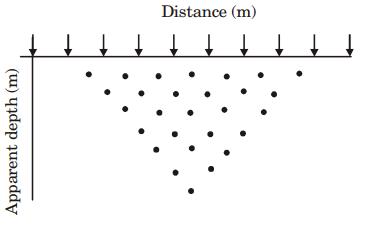
1. Multi-electrode resistivity survey is carried out by placing 10 equispaced electrodes (denoted by arrows in the figure below) on the surface of the earth. The points of observations in the distanceapparent depth plane are marked as solid dots in the figure shown below. Considering the mid-point of the 4-electrode array as the point of observation in the lateral direction, identify the CORRECT electrode configuration used for the survey.


(a) Multi-electrode Wenner array.     (b) Multi-electrode Axial Dipole-dipole array. 

(c) Multi-electrode Wenner-Schlumberger array. (d) Multi-electrode Axial Pole-dipole array

2. A student interpreted a four layer Schlumberger resistivity sounding data and obtained the resistivities (ohm) and thicknesses (h) as follows: p1 = 100 ohm-m, p2 = 20 ohm-m, p3 = 1500 ohm-m and p4 = 50 ohm-m; h1 = 50 m, h2 =10 m and h3 =20 m. The same data is interpreted by another student who obtains p3 = 2000 ohm-m. Then, according to the principle of equivalence, the value of h3 interpreted by the second student is ________m. (All other model parameters estimated by both the students are the same.) 

3. The apparent resistivities obtained at 0.1 Hz and 10 Hz in the frequency domain I.P. measurement are 100 ohm-m and 80 ohm-m, respectively. The Percentage Frequency Effect is _________.

GATE 2017

1. Given the following data for a resistivity sounding experiment over a two-layered half-space, the resistivity transform for the top layer is  ohm-m. 
(Data : resistivity of top layer p1 = 10 ohm-m, resistivity of half space p2= 100 ohm-m, thickness of top layer h1 = 10 m and current electrode spacing AB/2 = 5m ).


2. The apparent resistivity for Wenner and Schlumberger configurations in an electrical sounding experiment is the same for a certain electrode spacing ‘a’ (Wenner configuration). Given the current electrode spacing of 18 m and the potential electrode spacing of 2 m for a Schlumberger configuration, the value of ‘a’ is ________m. 

3. In a time-domain (TD) induced polarization experiment with a steady voltage of 10 mV during the current flow interval, the voltage decay after the current cut-off is given by \(v(t) = 4.0 \ e^-{0.3t}\) mV. The chargeability after current cut-off between t1 = 1 s and t2 = 4 s is __________ ms.

GATE 2016


GATE 2015

1. In which one of the following configurations the electrodes are uniformly spaced? 
(a) Schlumberger array 
(b) Pole-dipole array 
(c) Wenner array 
(d) Pole-pole array

2. Which type of VES curve is obtained for a three layered earth model consisting of wet shale (top layer), poorly water saturated sandstone (middle layer) and impermeable granite (bottom layer)? 
(a) K         (b) Q         (c) H         (d) A

3. In frequency domain IP, which one of the following frequency ranges (in Hz) is used to measure apparent resistivity at DC and AC limits? 
(a) 0.01 – 0.1 
(b) 0.1 – 1 
(c) 0.1 – 10 
(d) 10 – 100

GATE 2014

1. The reflection coefficient at the interface between two layers of resistivities 9 ohm-m and 1 ohm-m respectively is 
(a) 0.6         (b) 0.7         (c) 0.8         (d) 0.9

2. Compute the coefficient of anisotropy from the following parameters estimated from a Vertical Electric Sounding (VES) survey. 
Resistivity of first layer, p1 = 15 ohm-m 
Resistivity of second layer, p2 = 4 ohm-m 
Resistivity of lower half-space, p3 = 50 ohm-m 
Thickness of first layer, h1 =3m 
Thickness of second layer, h2 =16m 
(a) 1.43 (b) 1.28 (c) 1.19 (d) 1.13

3. Arrange the following electrode configurations in the ascending order of their depth of investigation (P) Dipole-Dipole (Q) Schlumberger (R) Wenner (S) Pole-Pole 
(a) R – S – Q – P (b) P – Q – S – R (c) R – Q – P – S (d) R – Q – S – P

GATE 2013


GATE 2012


GATE 2011


GATE 2010


GATE 2009


GATE 2018


GATE 2018

Share:

GATE Questions Well Logging

GATE 2009

1. 

GATE 2010


GATE 2011


GATE 2012


GATE 2013

1. Which of the following logging techniques is best suited to estimate the shaliness of hydrocarbon reservoirs? 
(a) Resistivity (b) Sonic (c) Induction (d) Gamma ray

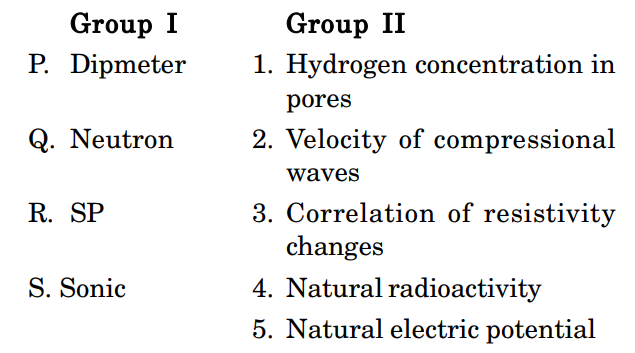
2. Match the items of Group I with those of Group II 

    Group I                                        Group II 
P) Caliper log                             1) Permeability 
Q) NMR log                               2) Resistivity 
R) Neutron log                           3) Diameter 
S) SP log                                    4) Velocity 
                                                   5) Porosity 
(a) P – 3, Q – 4, R – 2, S – 5                 (b) P – 3, Q – 1, R – 5, S – 2 
(c) P – 4, Q – 2, R – 4, S – 3                 (d) P – 1, Q – 3, R – 2, S – 4

GATE 2014

1. The following gamma r ay (GR) log data are recorded in a borehole: GR log value against a formation = 30 API units, Maximum GR log value = 45 API units, Minimum GR log value = 20 API units. What is the fraction of shale in the formation? 
(a) 0.33     (b) 0.40     (c) 0.66     (d) 0.75

2. Match the type of well logs (listed in Group I) with the characteristics of measurement (listed in Group II). 

(a) P – 3; Q – 1; R – 5; S – 2 (b) P – 4; Q – 1; R – 5; S – 3 (c) P – 3; Q – 4; R – 5; S – 2 (d) P – 3; Q – 1; R – 4; S – 2

GATE 2015

1. Which one of the following logging methods is NOT used to determine porosity? 
(a) Sonic (b) SP (c) Neutron (d) Gamma-gamma

2. A clean, thick and hydrocarbon bearing sandstone bed can be identified through a combination of 
(a) low SP and high resistivity     (b) large SP and high resistivity 
(c) low transit time and high resistivity     (d) large SP and low resistivity

3. I n a consolidated sandstone formation, the interval transit times of the formation, matrix and fluid are 70 µs, 55 µs and 190 µs respectively. The porosity of the formation is ______.

GATE 2016

1. In resistivity logging using a ‘Normal device’, the distance between electrodes A and M is 0.40 m. If 20 mA current generates 10 mV potential, the apparent resistivity of the layer between the electrodes is _________ ohm-m. (Use \(\pi\) = 3.14) 

2. A cylindrical sandstone core sample of diameter 0.02 m and length 0.04 m is fully saturated with brine solution of resistivity 0.5 ohm-m. The resistance of the saturated sample measured in the laboratory is 500 ohm. The formation factor of the sample is __________. (Use \(\pi\) = 3.14)

GATE 2017

1. Which one amongst the following logging tools has the largest depth of investigation? 
(a) Density (b) Laterolog 3 (c) Laterolog 8 (d) Neutron

2. The most abundant radioactive isotope in the continental crust is 
(a) \(_{40}K\) (b) \(_{232}Th\) (c) \(_{235}U\) (d) \(_{238}U\)

3. The characteristic log response of a thick coal seam are 
(a) low transit time, low resistivity and high gamma ray count. 
(b) low transit time, high resistivity and low gamma ray count. 
(c) high transit time, high resistivity and low gamma ray count. 
(d) high transit time, low resistivity and high gamma ray count.

4. The SP response of a thick, clean sandstone bed is – 54V. Given the mud filtrate resistivity to be 0.45 ohm-m at a formation temperature (\(T_f\)) of 130°F and the coefficient, K = 77.29, the formation water resistivity is _________ohm-m. 

5. Which one of the following log responses is TRUE for a porous and permeable sandstone bed, when the resistivity of the mud filtrate used in equal to the resistivity of the formation water? 
(a) A large negative SP is observed. 
(b) A large positive SP is observed. 
(c) LLs and LLm logs show appreciably large separation. 
(d) LLm and LLd logs overlap with each other.

GATE 2018

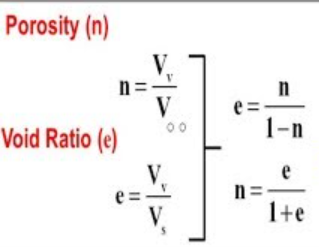
1. If the total porosity of a soil is 20%, its void ratio (%) is _________.

2. Assertion (a) : The Static Self-Potential for a thick , clean freshwater bearing sandstone formation is positive. 
Reason (r) : Resistivity of the formation water is less than the resistivity of salt water mudfiltrate. 
(a) Both (a) and (r) are true and (r) is the correct reason for (a). 
(b) Both (a) and (r) are true and (r) is not the correct reason for (a) 
(c) Both (a) and (r) are false. 
(d) (a) is true but (r) is false. 

3. Which one of the following well log responses characterizes an over pressured zone in the subsurface? 
(a) High velocity and high resistivity. 
(b) Low velocity and low density. 
(c) High velocity and low resistivity. 
(d) Low velocity and high density.

GATE 2019

1. Which one of the following clay minerals contain potassium (K)? 
(a) Illite     (b) Kaolinite 
(c) Montmorillonite     (d) Vermiculite

2. A high frequency acoustic wave propagating in a gas saturated sandstone formation exhibits an increase in __________ . 
(a) frequency (b) velocity (c) wavelength (d) wave number 

3. Which one of the following logging methods uses a radioactive source in the sonde? 
(a) Natural Gamma ray 
(b) Gamma-Gamma 
(c) Natural Gamma ray spectroscopy 
(d) Nuclear Magnetic Resonance (NMR)

4. Which one of the following is CORRECT for the density porosity (\(\phi_D\)) and neutron porosity (\(\phi_N\)) estimated for a finely interbedded organic-rich, shaly sandstone formation relative to those for a shale-free sandstone formation at shallow depths?
(a) \(\phi_N\) decreases and \(\phi_D\) increases. 
(b) \(\phi_N\) increases and \(\phi_D\) decreases. 
(c) Both \(\phi_N\) and \(\phi_D\) decrease. 
(d) Both \(\phi_N\) and \(\phi_D\) increase. 

5. Which one of the following statements is INCORRECT with regard to Nuclear Magnetic Resonance (NMR) logging? (\(\phi_{NMR}\) - NMR derived total porosity, \(\phi_N\) - Density porosity)
(a) The relaxation time (T2) decreases with decrease in pore size. 
(b) The \(\phi_{NMR}\) is greater than \(\phi_N\) in a water saturated sandstone formation. 
(c) The NMR logs provide lithology independent measurement of total porosity. 
(d) The \(\phi_{NMR}\) is less than \(\phi_D\) in a gas saturated shaly sandstone formation

6. The bulk resistivity of a carbonate formation having 10% porosity which is 75% saturated with hydrocarbons is 500 ohm-m. The bulk resistivity of the formation when the porosity is doubled and 100% saturated with water is ______ ohm-metres, (round off to 1 decimal place). 
(Assume the tortuosity, cementation factor and saturation exponent to be 1, 2 and 2, respectively).

GATE 2020

1. During ‘K - capture’ nuclear transmutation process 
(a) both atomic number and atomic mass increase 
(b) atomic number decreases but atomic mass remain same 
(c) atomic number increases but atomic mass remain same 
(d) both atomic number and atomic mass decreases

2. Which one amongst the following logs has the maximum depth of investigation? 
(a) Neutron log     (b) Natural Gamma - ray log 
(c) Lateral log     (d) Density log

3. Which one of the following does NOT contribute to the supression of SP log response for a thin, shaly, gas bearing sandstone formation? (Resistivity of mud filtrate > resistivity of formation water) 
(a) Increase in shale content 
(b) Increase in hydrocarbon content 
(c) decrease in the thickness of the bed 
(d) Increase in the salinity of formation water 

4. The crossover observed for a hydrocarbon-bearing sandstone formation in the plot Neutron and Density porosity logs (\(\phi_n\) – Neutron porosity and \(\phi_d\) –Density porosity) is due to 
(a) increase in \(\phi_d\) and decrease in \(\phi_n\)
(b) decrease in \(\phi_d\) and increase in \(\phi_n\)
(c) increase in both \(\phi_d\) and \(\phi_n\)
(d) decrease in both \(\phi_d\) and \(\phi_n\)


Share:

GATE Questions Seismic Method

GATE 2009

1. 

GATE 2010


GATE 2011


GATE 2012


GATE 2013


GATE 2014


GATE 2015


GATE 2016

1. Depth migration is applied to a stacked seismic section. Compared to the stacked section, dipping events in the migrated section 
(a) have a steeper slope and move updip. 
(b) remain unchanged. 
(c) have a gentler slope and move downdip. 
(d) have a steeper slope and move downdip. 

2. A monochromatic elastic wave of frequency 20 Hz propagates in a medium with average velocity 3 km/s. For zero offset reflection from horizontal reflectors, the thickness of the vertical first Fresnel zone is ________ m.

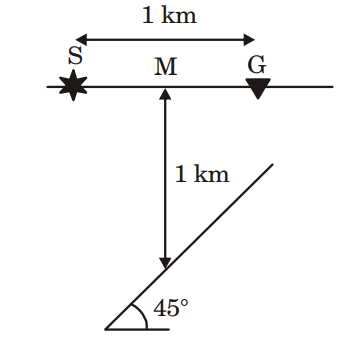
3. The following figure shows a seismic reflection experiment above a reflector that dips 45° . The P-wave velocity in the medium is constant and equal to 2 km/s. The source is kept at location ‘S’ and the receiver is kept at location ‘G’. The midpoint between S and G is denoted by ‘M’ and the depth to the reflector from ‘M’ is 1 km. The traveltime of the primary reflected arrival recorded at the receiver is equal to____ seconds.

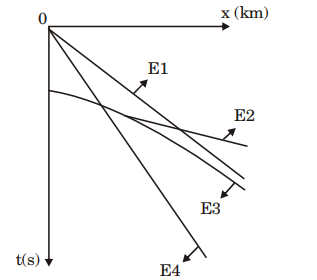
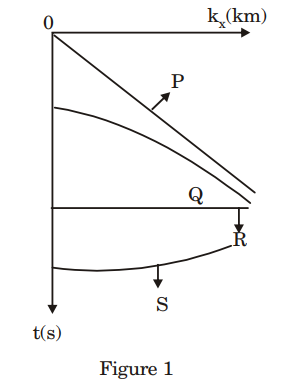
4. For land seismic data acquisition, the following figure is a schematic plot of arrival times of seismic waves recorded at several detectors placed along the x-axis. The shot is placed at the origin (x = 0).


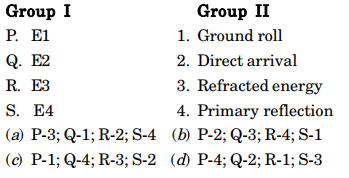
Match the events labeled in the figure (listed in Group I ) with their corresponding types (listed in Group I I)

GATE 2017

1. A seismic reflection survey was carried out over a subsurface consisting of a stack of horizontal isotropic layers. In the common midpoint (CMP) domain, the moveout (travel time v/s offset) curve for any primary reflection event is best approximated by 
(a) an ellipse (b) a parabola (c) a circle (d) a hyperbola

2. Normal movement (NMO) correction was applied to seismic data in the common midpoint (CMP) domain. The frequency distortion due to “NMO stretch” is highest for 
(a) larger offsets of deeper reflections. 
(b) smaller offsets of shallower reflections. 
(c) larger offsets of shallower reflections. 
(d) smaller offsets of deeper reflections. 

3. Consider a hypothetical zero-offset seismic reflection survey acquired over a reflector whose dip is 30°. The velocity of the medium above the reflector is 2 km/s and the trace spacing is 25 m. The maximum unaliased frequency in the data is _________ Hz. 

4. In statistical wavelet deconvalution, the reflectivity series is assumed to be a random sequence. Then, the autocorrelation of the wavelet is 
(a) a scaled version of the autocorrelation of the seismic trace. 
(b) a random sequence. 
(c) zero. 
(d) dirac-delta function.

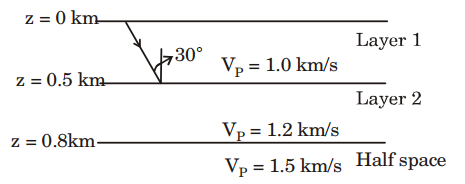
5. In the figure shown below, a ray corresponding to a P-wave is incident on the interface between layer 1 and layer 2 at an angle of 30°. The P-wave velocity is 1 km/s, 1.2 km/s and 1.5 km/s in layer 1, layer 2 and the half space, respectively. The emergence angle of the ray into the half space is _________ degrees.

6. How do the P-wave velocity (VP). S-wave velocity (V S), and Poisson’s ratio (\(\sigma\)) change fr om water saturated sandstone to a gas saturated sandstone? 
(a) Vp increases, Vs decreases and \(\sigma\) increases. 
(b) Vp decreases, Vs remains the same and \(\sigma\) decreases. 
(c) Vp decreases, Vs increases and \(\sigma\) decreases. 
(d) Vp, Vs and \(\sigma\) all remain constant.

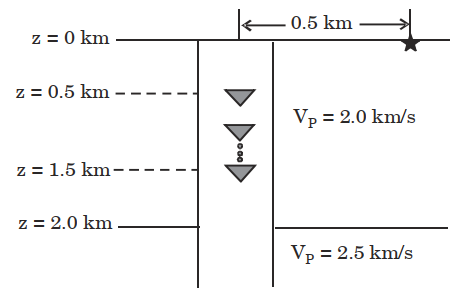
7. Consider a Vertical Seismic Profiling (VSP) data acquisition experiment as shown in the figure below. The subsurface consists of a horizontal layer of 2 km thickness underlain by a semi-infinite half-space. The P-wave velocities (VP) in the first layer and the half-space are 2.0 km/s and 2.5 km/ s, respectively. The vertical well has a string of receivers (denoted by inverted triangles) spaced 10 m apart, with the shallowest receiver at a depth of 0.5 km and the deepest receiver at a depth of 1.5 km. The source (denoted by star) is placed 0.5 km from the well head. The traveltime of the primary reflection event at the deepest receiver is ________s.

GATE 2018

1. The impulse response of the Kirchhoff pre-stack time migration operator for non-zero offsets in a homogeneous and isotropic medium is _______. 
(a) a circle     (b) a parabola     (c) a hyperbola     (d) an ellipse

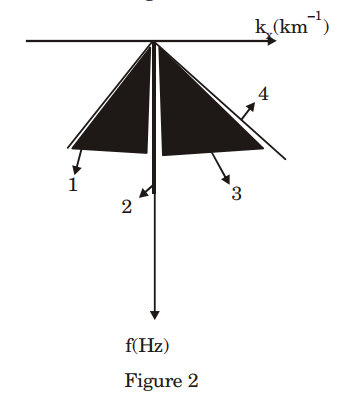
2. Figure 1 is a schematic diagram of four seismic events in t-x (time-offset) domain and Figure 2 is the result of transformation from t-x domain to fkx (frequency-horizontal wavenumber) domain. Match the events in t-x domain in Figure 1 with their counterparts in f-kx domain in Figure 2.


(a) P-1; Q-2; R-3; S-4 (b) P-1; Q-3; R-2; S-4 (c) P-4; Q-3; R-2; S-1 (d) P-4; Q-2; R-3; S-1

3. A horizontally travelling surface wave with a wavelength of 20 m is attenuated by a linear and uniform receiver array consisting of 4 receivers if the minimum receiver spacing is ________ m.

4. An end-on marine survey is carried out with equal and uniform shot and receiver spacing. If the total number of shots fired is 50 and a total of 10000 traces are recorded, the maximum fold for the survey is _______.

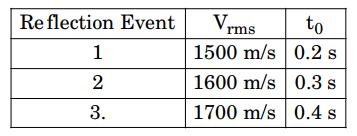
5. Consider a laterally homogeneous and isotropic ear t h model wi t h a fl at hor i zont al sur face and three hor izontal layers under lain by a halfspace. A seismic reflection survey was simulated on this model with the sources and receivers placed on the surface. The table below lists the root mean square (rms) velocities, V rms, and zero-offset two-way traveltimes t0 for the three reflection events from the bottom of each of the three layers observed in a pre-stack CDP (CMP) gather. The interval velocity of the second layer is _______ m/s.


GATE 2019

1. A reversed refraction survey was done over a two layered medium with the interface between them dipping at an angle of 15°. The velocities in the upper and lower medium are V1 and V2 respectively, with V2 > V1. If the critical angle is 45°, then, which one of the following isCORRECT? (V u and V d are updip and downdip velocities). 
(a) V 1 = Vd = Vu             (b) Vu > Vd > V1 
(c) V 1 > Vd < Vu             (d) Vu < Vd > V1

2. In a migrated seismic time section _______ . 
(a) both synclines and anticlines appear tighter 
(b) both synclines and anticlines appear broader 
(c) synclines appear tighter and anticlines appear broader 
(d) synclines appear broader and anticlines appear tighter.

3. A 3-D seismic tomography experiment was carried out with an inter-station spacing of ‘X’ km. The subsurface velocity perturbations in three dimensional blocks were estimated with block size of ‘2X’km and ‘0.5X’km in case 1 and case 2, respectively. Which one of the following statements is CORRECT? 
(a) The spatial resolution is poor and variance is small for case 1. 
(b) The spatial resolution is good and variance is small for case 2. 
(c) The spatial resolution is good and variance is large for case 1. 
(d) The spatial resolution is poor and variance is large for case 2.

4. A split-spread reflection survey is carried out along a profile in the direction of the dipping interface. The difference in arrival times of the reflected waves from the interface at two geophones with an offset distance of 1000 m from the shot-point on both sides is 20 msec. If the velocity of the layer above the dipping interface is 3000 m/s, then the dip of the bed is _______ degrees, (round off to 1 decimal place). (Assumption 2d >> X, where ‘d’ is depth below the shot-point normal to the interface and X is the source-geophone spacing)

5. A vibroseis source sweeps acoustic signal in the frequency range 10 Hz – 100 Hz. The maximum sampling interval to correctly recover the recorded signal will be _________ milliseconds.

GATE 2020

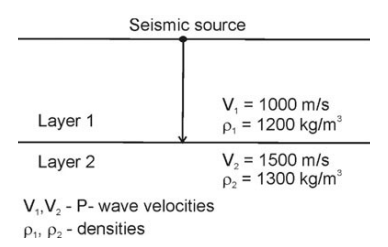
1. The transmission coefficient for the vertically incident seismic wave at the interface between Layer 1 and Layer 2 given in the figure is______. (Round off to 2 decimal places)
2. Assuming uncorrelated noise, the improvement in the signal to noise ratio in a reflection seismic survey with ‘n’ geophones spaced equally along the profile is proportional to
(a) \(n\) (b) \(\frac{1}{n}\) (c) \(\sqrt{n}\) (d) \(\frac{1}{\sqrt{n}}\)

3. A waveform with amplitude spectrum A (\(\omega\)) and phase spectrum \(\phi(\omega)\) is autocorrelated. Which one of the option given below correctly represents the information about the original waveform that can be retrieved from the autocorrelated waveform? 
(a) A(\(\omega\)) can be retrieved but not \(\phi(\omega)\)
(b) \(\phi(\omega)\) can be retrieved but not A(\(\omega\)) 
(c) Both \(\phi(\omega)\) and A(\(\omega\)) can be retrieved 
(d) Both \(\phi(\omega)\) and A(\(\omega\)) cannot be retrieved

4. In a 3D seismic survey, there are 512 groups of receivers in one line of a patch. Eight groups are moved per line from one patch to the next along the swath. What is the inline fold?
(a) 32 (b) 16 (c) 8 (d) 4

5. A sample of granite is observed to have a P-wave velocity of 5km/s and density of 2600kg/m3. The bulk modulus of the granite, assuming it to be a Poisson’s solid, is ______kilo-Pascal(kPa). (Round off to 2 decimal places)

6. A seismic reflection survey is carried out over a 1500m thick horizontal layer with a P-wave velocity of 2000m/s. The travel time of reflected wave at a surface detector placed 1000m from a surface source is ______ milliseconds. 

7. A seismic reflection survey is carried out using a 10 milliseconds seismic wavelet over a subsurface medium having an average P-wave velocity of 1600m/s. The best resolution which is obtained on the basis of Rayleigh criteria is ______ m (Assume seismic wavelet contains one cycle)

8. A 10 Hz seismic wave propagates for 40 km through a material with a P-wave velocity of 5 km/s and quality factor (Q) of 100. The percentage of the initial amplitude retained in the attenuated wave is ________. (Round off to 1 decimal place) (Use \(\pi\) = 3.14)


Share:

GATE Questions Seismology

GATE 2009

1. The Gutenberg discontinuity is located at a depth of around 
(a) 35 km (b) 150 km (c) 2900 km (d) 5000 km

2. A vast majority of earthquake sources are often linked to 
(a) inner core                                     (b) outer core 
(c) brittle part of the earth’s crust     (d) molten part of earth’s mantle

3. The teleseismic rays are those that arrive at a seismometer for a distance greater than 
(a) 18° (b) 28° (c) 38° (d) 48°

4. Which is the parameter for measuring the size of the earthquake that does not need an instrumental record? 
(a) Richter Magnitude (b) Intensity (c) Moment (d) Mw

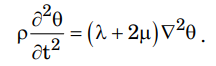
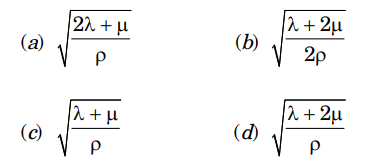
5. The standard form of wave equation for propagation of cubical dilatation (\(\theta\)) is
The compressional wave velocity is given by
6. PKI KP is a seismic body wave which travels through 
(a) upper mantle                         (b) upper and lower mantle 
(c) mantle, outer core and inner core         (d) mantle and outer core.

GATE 2010

1. Cooling of basaltic lava under water will lead to the formation of 
(a) lava tunnel (b) pillow structure (c) columnar jointing (d) cumulus texture 

2. What rock would you expect to find at the base of a typical oceanic plate? 
(a) Basalt (b) Diorite (c) Gabbro (d) Peridotite

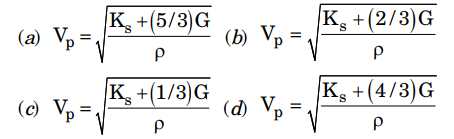
3. The compressional wave velocity V p , within a wild with adiabatic bulk modulus K f, rigidity modulus G and density \(\rho\) is given by
4. The number of independent elements of the 4th order stiffness tensor required to characterize general elastic media is 
(a) 2 (b) 21 (c) 36 (d) 81

5. The seismic energy released in an earthquake of magnitude Ms = 7.0 is about ________ times that released in an earthquake of Ms = 6.0. 
(a) 10 (b) 32 (c) 64 (d) 100

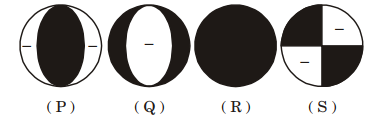
6. In the figure given below "– " represents dilatation and "+" represents compression. The fault plane solution of an earthquake with strike-slip mechanism is represented by
7. The anelastic attenuation of seismic energy depends on 
(a) quality factor     (b) particle acceleration     (c) stress drop     (d) particle velocity 

8. The seismic wave travelling in low velocity layer and critically incident at the discontinuity between low and high velocity layers 
(a) will be diffracted         (b) will be reflected 
(c) will propagate along the discontinuity         (d) will be absorbed

GATE 2011

1. The P-wave velocity of the earth’s mantle at the Mohorovicic discontinuity is 
(a) 5.5 km/s (b) 6.0 km/s (c) 7.0 km/s (d) 8.0 km/s

2. Tsunamis are 
(a) gravity waves (b) acoustic waves (c) capillary waves (d) internal waves

3. In a formation, if the density increases and elastic constants remain unchanged, then 
(a) both P and S wave velocities increase 
(b) P wave velocity increases and S wave velocity decreases 
(c) both P and S wave velocities decrease 
(d) P wave velocity decreases and S wave velocity increases

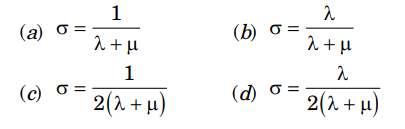
4. The Poisson ratio (\(\sigma\)) for rocks in terms of Lame’s constants \(\lambda\) and \(\mu\) is
5. Shadow zones for direct P- and S-waves lies between 
(a) 102° to 142° for both direct P- and S-waves 
(b) 102° to 180° for direct P- wave and 102° to 142° for direct S-wave 
(c) 102° to 180° for both direct P- and S-waves 
(d) 102° to 142° for direct P- wave and 102° to 180° for direct S-wave 

6. Snell’s law of refraction deals with which of the following properties of refracted waves? 
(a) amplitude (b) direction (c) energy (d) phase

GATE 2012

1. Depth range of the ‘transition zone’ associated with phase changes in the Earth’s mantle is (in km) 
(a) 35 to 150 (b) 150 to 410 (c) 410 to 660 (d) 660 to 800

2. The S-wave velocity in the lower continental crust is 6800 m/s and its density is 3380 kg/m3. Find its rigidity in GPa. (Give answer up to 2 decimal places) 
(a) 156.29 (b) 160.21 (c) 162.34 (d) 500

Statement for Linked Answer Questions 3 and 4: 

The seismic slip of a fault after an earthquake is measured to be 0.5 m and the fault area is estimated to be 250 km2 . The rigidity of the medium surrounding the fault is 30 GPa. 

3. The seismic moment (in Nm) of the earthquake is 
(a) \(3.75 \times 10^{18}\) (b) \(3.75 \times 10^{16}\) (c) \(3.75 \times 10^{14}\) (d) 3.75 \times 10^{121}\) 

4. . Based on the above, the moment magnitude of the earthquake is 
(a) 5.15 (b) 5.36 (c) 6.35 (d) 7.25

GATE 2013

1. Both strength and plasticity of a rock increase with the 
(A) increase in temperature     (B) decrease in strain rate 
(C) increase in confining pressure     (D) increase in pore fluid pressure 

2. Amongst the following options, the acceptable value of the Poisson’s ratio of a rock is 
(a) 0.55     (b) 1.00     (c) 0.25     (d) -1.00

3. The type of wave that arrives first at a station from an earthquake hypocenter is 
(a) P-wave (b) S-wave (c) Rayleigh wave (d) Love wave

4. Which of the following is NOT an inverse square law? 
(a) Newton’s law of gravitation         (b) Coulomb’s law of electrostatics 
(c) Coulomb’s law of magnetostatics         (d) Hooke’s law

5. For seismic S-wave velocity, V, the rigidity modulus, µ, is proportional to 
(a) \(\sqrt{V}\) (b) \(V\) (c) \(V^2\) (d) \(V^3\)

6. In a homogeneous anisotropic medium, the physical property varies 
(a) with position but not with direction 
(b) with both position and direction 
(c) with direction but not with position 
(d) neither with position nor with direction

7. Which of the following ways of measuring the size of an earthquake does not require instrumental recording? 
(a) Richter magnitude (b) Moment (c) Mw (d) Intensity

8. Wadati diagram is a plot of the difference in P and S- wave arrival times against the arrival time of P-wave. It helps in estimating the
(a) velocity of P-wave.     (b) velocity of S-wave. 
(c) time of occurrence of earthquake.     (d) hypocenter of earthquake.

GATE 2014

1. From the surface to the Earth’s interior, the velocity of P-wave decreases and the material density increases at the boundary between
(a) Outer core and inner core     (b) Mantle and outer core 
(c) Crust and mantle     (d) Upper crust and lower crust

2. As compared to large earthquakes, small earthquakes are 
(a) more frequent and caused by short fault slip and long rupture lengths 
(b) more frequent and caused by long fault slip and short rupture lengths 
(c) less frequent and caused by short fault slip and short rupture lengths 
(d) more frequent and caused by short fault slip and short rupture lengths

3. For earthquakes of magnitudes 6 and 7, the seismic wave amplitudes are A 6 and A 7 and the radiated energies are E 6 and E 7 respectively. Which one of the following is true? 
(a) \(A_7\approx \frac{7}{6} A_6 \ and \ E_{7}\approx10E_6\)
(b) \(A_7\approx 10 A_6 \ and \ E_{7}\approx100E_6\)
(c) \(A_7\approx 10A_6 \ and \ E_{7}\approx \frac{7}{6} E_6\) 
(d) \(A_7\approx 10 A_6 \ and \ E_{7}\approx32E_6\)

4. The velocity discontinuity between the upper crust and the lower crust is known as __________ discontinuity. 
(a) Lehmann (b) Gütenber (c) Mohorovicic (d) Conrad

5. The S-wave veloci t y of a medium havi ng a Poisson’s ratio and a P-wave velocity of 0.5 and 3 km/s respectively is _________km/s. 

6. The PKiKP phase denotes the passage of a seismic wave in the Earth as 
(a) P in mantle, S in outer core, reflected as P from inner-outer core boundary, S in outer core, P in mantle and crust 
(b) P in crust, P in mantle, reflected as P from core-mantle boundary, P in mantle, P in crust 
(c) P in mantle, P in outer core, P in inner core, P in outer core, P in mantle and crust 
(d) P in mantle, P in outer core, reflected as P from inner-outer core boundary, P in outer core, P in mantle and crust

GATE 2015

1. PcP and ScS phases are reflected from 
(a) crust - mantle boundary 
(b) core - mantle boundary 
(c) inner core - outer core boundary 
(d) lithosphere - asthenosphere boundary

2. Gardner’s formula relates the seismic P-wave velocity (VP ) to 
(a) density (b) porosity (c) permeability (d) lithology

3. Analysis of data from a 3-component broadband seismological station yields seismic velocities, Vp = 7.0 km/s and Vs = 3.87 km/s for the lower crust. The resulting Poisson’s ratio of the lower crustal rocks (rounded to two decimal places) is 
(a) 0.24         (b) 0.26         (c) 0.28         (d) 0.30

GATE 2016

1. Which one of the following layers of the Earth has the largest volume? 
(a) Upper Mantle (b) Lower Mantle (c) Outer core (d) Inner Core 

2. The S-wave shadow zone of the Earth ranges from ________. 
(a) 103° to 180° (b) 103° to 160° (c) 103° to 153° (d) 103° to 143°

3. Which one of the following is the ray path for the P-wave that converts to S-wave while passing through the solid inner core? 
(a) PKiKP (b) PKIKP (c) pPcP (d) PKJKP

4. Which one of the following statements is CORRECT for the stress drop (\(Delta \sigma\)) of an earthquake? 
(a) Large slip on a small fault will cause more stress drop. 
(b) Small slip on a large fault will cause more stress drop. 
(c) Stress drop is inversely proportional to the slip of the fault. 
(d) Stress is directly proportional to the rupture dimension. 

5. The energy released by an earthquake of magnitude 7 is ________ times the energy released by an earthquake of magnitude 4 (use Kanamori’s formula).

GATE 2017

1. A seismic gap refers to a 
(a) time gap between two great earthquakes. 
(b) distance gap between the epicenters of two great earthquakes. 
(c) segment of an active belt where a historical great earthquake has no occurred. 
(d) wide gap in the earth created by a great earthquake 

2. The travel time difference between the arrival times of a shear wave (S) and primary wave (P) observed on a seismogram recorded at an epicentral distance of 100 km from a near surface earthquake is _________s. 
(Assume the average P and S wave velocities to be 6.0 km/s and 3.5 km/s, respectively). 

3. The percentage increase in P-wave velocity (km/ s) across the Mohorovicic discontinuity from the lower crust to the upper mantle beneath craton is approximately ___________(%).

4. Which one of the following seismic phases is observable in the P-wave shadow zone? 
(a) P (b) PmP (c) PcS (d) PKiKP

5. Which one of the following statements is TRUE for near surface earthquake occurring in a homogeneous, isotropic Earth? 
(a) Rayleigh wave are generated     (b) Love waves are generated. 
(c) Shear waves are split.     (d) P waves undergo refraction. 

6. A dynamic range of 60 dB in power corresponds to an increases in amplitude by a factor of ______. 

7. The slope of the Wadati plot obtained using the P and S arrival times of a local earthquake is 1.0 The corresponding Vp/Vs ratio of the subsurface medium is _________. 

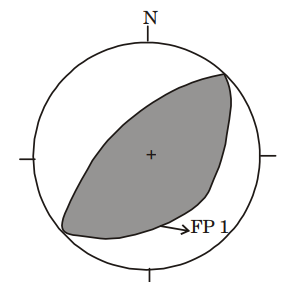
8. The beach ball figure given below depicts the focal mechanism of an earthquake. The shades and unshaded portions indicate compressional and dilatational quadrants, respectively. FP1 is the fault plane solution. The focal mechanism and FP1 represent


(a) a thrust fault with strike 45° and 30° with the tension axis in the compression quadrant. (b) a normal fault with strike 45° and 30° with the tension axis in the compression quadrant. (c) a thrust fault with strike 225° and 60° with the tension axis in the compression quadrant. (d) a normal fault with strike 225° and 60° with the tension axis in the compression quadrant.

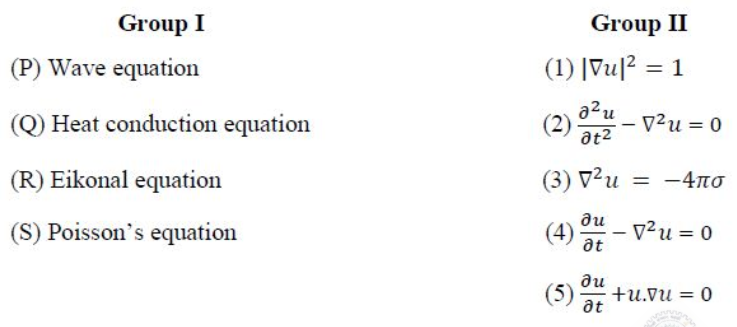
9. Match the items listed in Group I with their respective analytical expressions in Group II.

(a) P-2; Q-3; R-4; S-1         (b) P-2; Q-4; R-1; S-3 
(c) P-4; Q-2; R-5; S-3         (d) P-4; Q-3; R-1; S-5

GATE 2018

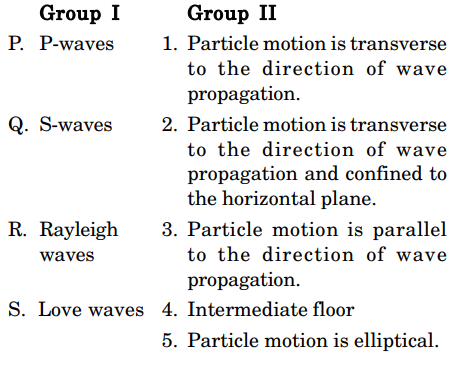
1. For a layered isotropic medium with a flat horizontal free surface, match the wave types listed in Group-I with their corresponding polarizations listed in Group II


(a) P-1; Q-3; R-4; S-2 (b) P-3; Q-1; R-4; S-2 (c) P-3; Q-1; R-2; S-4 (d) P-2; Q-3; R-1; S-4

2. The unit of shear modulus (rigidity modulus) is 
(a) kg m– 1 s– 2 (b) m2 s– 2 (c) kg m– 2 s– 2 (d) m– 1

3. Assume a flat earth with crustal thickness of 35 km and average crustal and upper mantle P-wave velocities of 6.4 km.s– 1 and 8.1 km.s– 1, respectively. The minimum distance from the epicenter of a near surface earthquake at which Pn -waves are observed is _______ km.

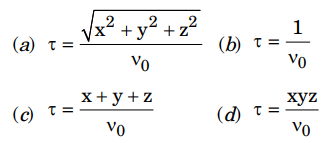
4. A solution to the eikonal equation \(|\nabla \tau|=\frac{1}{V_0}\) for homogeneous and isotropic medium in cartesion coordinates is

5. There is a change in t he values of t he bulk modulus and density across the Gutenberg discontinuity (from mantle to outer core). Which one of the following statements is CORRECT? 
(a) Both bulk modulus and density increase. 
(b) Both bulk modulus and density decrease. 
(c) Bulk modulus decreases and density increases. 
(d) Bulk modulus increases and density decreases.

6. Using t he Gutenberg-Richter recurrence relationship, the mean annual rate of exceedance of earthquake occurrence in a seismic belt is 0.3 per year for an earthquake of magnitude 6.0. The return period for an earthquake of magnitude 6.0 in this belt is ______ years.

7. The P-wave velocity and the Poisson’s ratio for a homogeneous and isotropic sedimentary rock are 2500 m/s and 0.3, respectively. The S-wave velocity for the rock is ________m/s.

GATE 2019

1. Body waves __________ . 
(a) can travel through vacuum (b) have cylindrical wavefronts 
(c) are mechanical waves (d) are known as ground roll 5

2. The acceleration due to gravity (g) begins to fall sharply towards the centre of the Earth from the __________ discontinuity. 
(a) Conrad (b) Mohorovicic (c) Gutenberg (d) Lehmann 

3. Which one of the following lists ONLY kinematic parameters? 
(a) Force, translation, rotation. 
(b) Translation, rotation, distortion. 
(c) Stress, distortion, translation. 
(d) Force, stress, strain.

4. The Young’s modulus ‘E’ is related to the Lame’s parameter ‘A,’ for a Poisson solid as 
(a) E = 2.5\(\lambda\), (b) E = 1.5\(\lambda\) (c) E = \(\lambda\) (d) E = 0.5\(\lambda\). 

5. Which one of the following seismic phases is the earliest arrival in the P shadow zone?
(a) PKiKP (b) PPP (c) P diff (d) PKIKP

6. A shallow focus, Great earthquake with seismic moment of 2.5 × 1040 dyne-cm is recorded at an epicentral distance of 50°. The body wave magnitude (mb), surface wave magnitude (Ms) and moment magnitude (Mw) were estimated. Which one of the following is CORRECT? 
(a) mb > Ms > Mw         (b) mb = Ms = Mw 
(c) mb < Ms < Mw         (d) mb < Ms > Mw

7. In a seismogram of a shallow focus (h = 5 km) earthquake, the difference between the arrival times of the S and P phases is 1.34 s. Assuming the average P wave velocity of the crust to be 6.0 km/s and the Poisson’s ratio to be 0.27, the epicentral distance is _____ kilometres, (round off to 1 decimal place).

GATE 2020

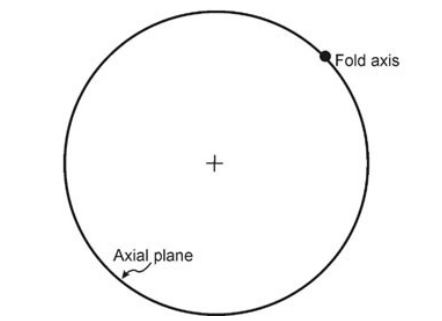
1. The given stereoplot of the axial plane and the axis of a fold represents an/a

(a) upright fold (b) vertical fold (c) reclined fold (d) recumbent fold.

2. Which of the following options shows the internal structure units of the Earth arranged in the CORRECT sequence of increasing volume? 
(a) Outer core < Inner core < Upper mantle < Lower mantle 
(b) Outer core < Inner core < Lower mantle < Upper mantle 
(c) Inner core < Outer core < Upper mantle < Lower mantle 
(d) Inner core < Outer core < Lower mantle < Upper mantle

3. Which one of the following is NOT an earthquake intensity scale? 
(a) Richter scale (b) JMA scale (c) Modified Mercalli scale (d) Rossi-Forel scale

4. Assuming the inner core of the Earth to be one-third of its present size, which one of the following satement is CORRECT ? (Radius of the Earth and outer core remain unchanged) 
(a) Shadow zone of P-wave increases but that of S-wave decreases 
(b) Shadow zone of P-wave increases but that of S-wave remains unchanged 
(c) Shadow zone of P-wave increases but that of S-wave increases 
(d) Shadow zone of P-wave decreases but that of S-wave remains unchanged


Share:

GATE Questions Magnetic Method

2011

1. The Larmor precession frequency (in Hz) measured by proton precession magnetometer for a total field of 50,000 nT is (gyromagnetic ratio of proton \(\gamma_p = 0.267513 \ nT^{-1}S^{-1}\) )

(a) 1890 (b) 2020 (c) 2130 (d) 2420
Share:

Structural Geology

When the sedimentary rock beds are found to have been deposited without interruption the age difference(s) between adjacent beds are negligible (geologically). We refer such contacts formed between layers and within such sequences as conformable depositional contacts. Conformable depositional contacts are usually planar to slightly irregular in form.

Unconformities

An unconformity is a depositional contact between two rocks of measurably different ages.


Where conformable deposition was interrupted, or where erosion during long intervals removed a part of the rock record an unconformity is formed. The unconformity in places will separate young horizontal sedimentary rocks from older, tilted, deformed sedimentary rocks. In other places the young horizontal sedimentary rocks may rest directly on an erosionally carved surface on old granite or schist. Again, the unconformity marks a gap in the rock record. Time is missing.

Unconformities are divided into three major classes: nonconformities, angular unconformities, and disconformities.

Nonconformity: A geological surface that separates younger overlying sedimentary strata from eroded igneous or metamorphic rocks and represents a large gap in the geologic record.

Nonconformity = top of basement rocks


Angular unconformity: An angular unconformity is an unconformity that separates layers above and below that are not parallel. Classical angular unconformities are horizontal depositional surfaces separating relatively young horizontal strata above from older steeply dipping strata below.

Angular unconformity = hiatus, erosion, and tilt


Disconformity: A disconformity is an unconformity separating strata that are parallel to each other. Some disconformities are highly irregular whereas others have no relief and can be difficult to distinguish within a series of parallel strata. Recognition may require complete knowledge of the ages of beds within the sequence of strata that contains the disconformity.

Disconformity = hiatus + erosion


For all three types of unconformity, the surface marking the unconformity itself is parallel to the bedding or layering of the rocks above the unconformity. The bed directly above an unconformity commonly contains a basal conglomerate, normally composed of clasts of the rock directly beneath the unconformity. Basal conglomerates itself declares erosional intervals. The basal conglomerate may range in coarseness from a thin fine granule conglomerate to a thick coarse boulder conglomerate. Surfaces of unconformity may locally possess topographic relief that can be recognized as the product of ancient erosion, perhaps even including the preservation of the cross-section of an old stream channel. Under ideal conditions, fossil soil profiles, called paleosols, are preserved in rocks directly beneath the old erosion surface. These may be baked where overlain by lava flows.

Paraconformity

A paraconformity is a type of unconformity in which strata are parallel; no apparent erosion is discernable and the surface of the unconformity resembles a simple bedding plane. It is also called pseudoconformity or nondepositional unconformity. Short paraconformities are called diastems.

Paraconformity = hiatus ± erosion (no discernable erosion)


Diastem

A relatively short interruption in sedimentation, involving only a brief interval of time, with little or no erosion before deposition is resumed; a depositional break of lesser magnitude than a paraconformity, or a paraconformity of very small time value.

Diastem = short hiatus ± erosion (a minor paraconformity)
Share:

Traps

NOMENCLATURE OF A TRAP

The highest point of the trap is the crest, or culmination. 

The lowest point at which hydrocarbons may be contained in the trap is the spill point; this lies on a horizontal contour, the spill plane.

The vertical distance from crest to spill plane is the closure of the trap.

The zone immediately beneath the petroleum is referred to as the bottom water, and the zone of the reservoir laterally adjacent to the trap as the edge zone.

Fig1: Cross section through a simple anticlinal trap

Within the trap the productive reservoir is termed the pay. 

The vertical distance from the top of the reservoir to the petroleum/water contact is termed gross pay.   

All of the gross pay does not necessarily consist of productive reservoir, so gross pay is usually differentiated from net pay. 

The net pay is the cumulative vertical thickness of a reservoir from which petroleum may be produced. Development of a reservoir necessitates mapping the gross : net pay ratio across the field.

Within the geographic limits of an oil or gas field there may be one or more pools, each with its own fluid contact.


This field contains two pools, with different oil : water contacts (OWC). In the upper pool the net pay is much less than the gross pay because of non-productive shale layers. In the lower pool the net pay is equal to the gross pay.

DISTRIBUTION OF PETROLEUM WITHIN A TRAP

A trap may contain oil, gas, or both. The oil : water contact (OWC) is the deepest level of producible oil. Similarly, the gas : oil contact (GOC) or gas : water contact is the lower limit of producible gas. 

Where oil and gas occur together in the same trap, the gas overlies the oil because the gas has a lower density. 

Whether a trap contains oil and/or gas depends both on the chemistry and level of maturation of the source rock and on the pressure and temperature of the reservoir itself. 

Fields with thick oil columns may show a more subtle gravity variation through the pay zone. Boundaries between oil, gas, and water may be sharp or transitional. Abrupt fluid contacts indicate a permeable reservoir; gradational ones indicate a low permeability with a high capillary pressure. Not only does a gross gravity separation of gas and oil occur within a reservoir, but more subtle chemical variations may also exist. 

Tar Mats

Some oil fields have a layer of heavy oil, termed a tar mat, immediately above the bottom water. Tar mats are very important to identify and understand because they impede the flow of water into a reservoir when the petroleum is produced.

Fluid Contacts  

Fluid contacts in a trap are generally planar, but are by no means always horizontal. Correct identification of the cause of the tilt is necessary for the efficient production of the field. There are several causes of tilted fluid contacts.

They may occur where a hydrodynamic flow of the bottom waters leads to a displacement of the hydrocarbons from a crestal to a flank position. This displacement can happen with varying degrees of severity. 


In some fields the OWC has tilted as a result of production, presumably because of fluid movement initiated by the production of oil from an adjacent field. 

An alternative explanation for a sloping fluid contact is that a trap has been tilted after hydrocarbon invasion, and the contact has not moved. 

A third possible cause of a tilted OWC may be a change in facies. 

SEALS AND CAP ROCKS

For a trap to have integrity it must be overlain by an effective seal. Any rock may act as a seal as long as it is impermeable. Seals will commonly be porous, and may in fact be petroleum saturated, but they must not permit the vertical migration of petroleum from the trap. Shales are the commonest seals, but evaporites are the most effective. Shales are commonly porous, but because of their fine grain size have very high capillary forces that prevent fluid flow. 

Shales may selectively trap oil, while permitting the upward migration of gas. Gas chimneys may sometimes be identified on seismic lines either by a velocity pull-down of the reflector on top of the reservoir, and/or by a loss in seismic character in the overlying reflectors. Indeed some petroleum accumulations are sometimes identified because of their gas-induced seismic anomalies.

CLASSIFICATION OF TRAPS


Share: